
What is the actual Tariff from China to the US today. Is it currently at 30% while there are in negotiations?
I’ve tried to look it up, but it’s not clear exactly what it is.
submitted by /u/Dano558
[link] [comments]
#462 – Inside China’s Amazon Seller Schools: 4,000 Students & One Mission
Join us as we welcome Feng Xiaoxiao, a distinguished leader in the Chinese e-commerce community and a driving force behind 4,000 Amazon sellers in Shenzhen. Known as Professor Xiaoxiao, Feng shares her compelling journey from Shenzhen to New York, where she is currently pursuing a master’s in integrated marketing at NYU. Feng provides insightful perspectives on the hurdles Chinese Amazon sellers face, such as high advertising costs and cultural misunderstandings, which impede their efforts to establish robust brands in the U.S. market. Her dedication to bridging these cultural gaps offers a unique lens into the e-commerce challenges faced by both Chinese and American sellers.
Listen in as we explore the complexities of intellectual property (IP) awareness among Chinese sellers, heightened by Amazon’s strict IP policies. Through education and adaptation, many are now prioritizing innovation and registering patents, although IP infringement remains a significant issue. We discuss the contrasting strengths of American and Chinese sellers, where Americans shine in innovation and branding, and Chinese sellers excel in product enhancement and cost reduction. This episode also touches on the misconceptions Americans may have about modern China and the potential for cross-cultural learning to enhance e-commerce strategies on platforms like Amazon.
In a fascinating conversation about cross-cultural marketing, we dive into the intersection of Chinese and American e-commerce sellers, emphasizing the necessity of mutual learning. Feng shares success stories and highlights the importance of cultural understanding and aesthetic alignment in improving brand appeal. We also discuss strategies for targeting specific U.S. audiences, using tools like Facebook data to find unique market positions. As we wrap up, the discussion turns to the opportunities for collaboration between Chinese and American sellers, aiming to foster fair competition and mutual growth in the competitive landscape of global e-commerce.
In episode 462 of the AM/PM Podcast, Kevin and Xiaoxiao discuss:
- 00:00 – Challenges of Chinese Amazon Sellers
- 02:33 – Global Connections Through Technology
- 06:20 – Challenges of Building US Brand
- 14:39 – Chinese Amazon Sellers & IP Infringements
- 19:01 – Cross-Cultural Marketing in E-Commerce
- 22:59 – Cultural Influence on Conversion Rates
- 29:08 – Market Research and Cultural Understanding
- 33:06 – Marketing Strategies and Consumer Data
- 37:25 – Reliability of Academic vs AI Data
- 41:27 – Opportunities for Chinese and American E-Commerce Seller Collaboration
- 48:01 – Amazon Business Owner Seeks Branding Help
- 54:07 – Common Ground Between East and West
Enjoy this episode? Want to be able to ask questions to Kevin King live in a small group with other 7 and 8-figure Amazon sellers? Join the Helium 10 Elite Mastermind and get monthly workshops, training, and networking calls with Kevin at h10.me/elite
Make sure to subscribe to the podcast on iTunes, Spotify, or wherever you listen to our podcast!
Want to absolutely start crushing it on eCommerce and make more money? Follow these steps for helpful resources to get started:
- Get the Ultimate Resource Guide from Kevin King for tools and services that he uses every day to dominate on Amazon!
- New to Selling on Amazon? Freedom Ticket offers the best tips, tricks, and strategies for beginners just starting out! Sign up for Freedom Ticket.
- Trying to Find a New Product? Get the most powerful Amazon product research tool in Black Box, available only at Helium 10! Start researching with Black Box.
- Want to Verify Your Product Idea? Use Xray in our Chrome extension to check how lucrative your next product idea is with over a dozen metrics of data! Download the Helium 10 Chrome Extension.
- The Ultimate Software Tool Suite for Amazon Sellers! Get more Helium 10 tools that can help you optimize your listings and increase sales for a low price! Sign up today!
- Does Amazon Owe YOU Money? Find Out for FREE! If you have been selling for over a year on Amazon, you may be owed money for lost or damaged inventory and not even know it. Get a FREE refund report to see how much you’re owed!
- Check out our other Amazon FBA podcasts including the Serious Sellers Podcast, as well as our Spanish and German versions!
- You can also listen to the AM/PM Podcast on YouTube here!
The post #462 – Inside China’s Amazon Seller Schools: 4,000 Students & One Mission appeared first on AM/PM Podcast.
What is the Amazon Buy Box? (And How to Win It)
What if one small box on an Amazon product page could make or break your business?
In this blog, you’ll learn what the Buy Box is, why it exists, how it works, and practical ways to win it consistently.
Overview
What is the Buy Box on Amazon?
The Buy Box, now officially called the Featured Offer, is the most valuable space on an Amazon product page. It’s located on the right-hand side of the listing and contains the Add to Cart and Buy Now buttons along with price, shipping options, stock status, and the selling offer.
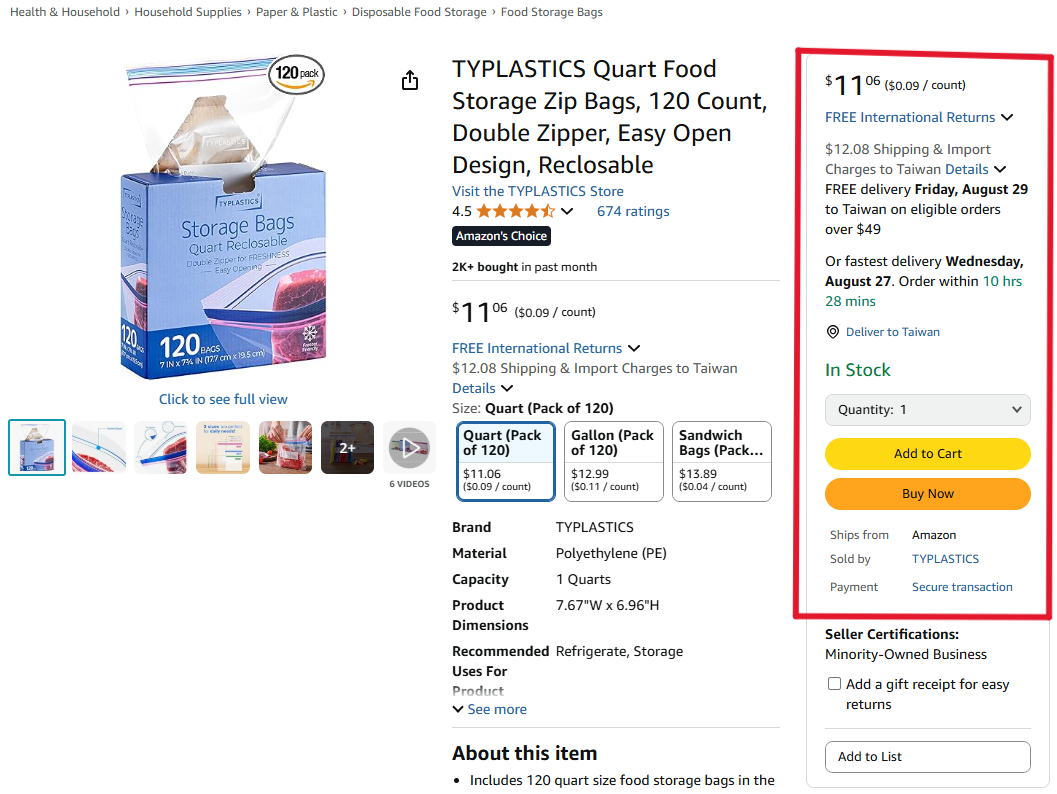
Why does the Amazon Buy Box exist?
Multiple sellers can offer the same product. To reduce decision fatigue and speed up checkout, Amazon highlights one primary offer. Shoppers can still view all offers, but the Buy Box gives a fast, trusted choice. Amazon favors sellers who consistently deliver a smooth experience: reliable shipping, accurate listings, and responsive support.
Why is the Buy Box important for sellers?
Roughly 80-90% of conversions on a listing occur through the Buy Box. Sellers without it may see only 10–20% of the sales volume. Securing the Featured Offer can trigger an immediate increase in sales velocity.
How does the Amazon Buy Box work?
An algorithm selects the Featured Offer based on eligibility, performance, pricing, and fulfillment. The Buy Box can rotate among eligible sellers throughout the day.
Jump to: Key Metrics
Buy Box Eligibility
What does “Buy Box eligible” mean?
Being Buy Box eligible means you meet Amazon’s baseline requirements to compete for the Featured Offer. Eligibility doesn’t guarantee that you win the Buy Box, rather it would rotate among eligible sellers depending on performance, pricing, and fulfillment.
Eligibility requirements for the Buy Box
- Professional Seller account (approx. $39.99/month).
- Sell new products (used items have a separate Buy Box).
- Maintain strong performance metrics like reliable fulfillment and stock management (see “Key Metrics” for more info).
Why am I not eligible? In Seller Central, enable the “Buy Box Eligible” column (Inventory → Buy Box Eligible). If you have met the basic requirements but you’re still not winning the Buy Box, review account health (ODR, shipping speed, inventory levels). Contact Amazon’s Seller Support if you’re still unclear.
What key metrics influence the Buy Box?
Amazon’s algorithm takes multiple factors into consideration, while price matters, Amazon weighs overall seller performance heavily:
Core factors
- Pricing: Stay competitive, and not always the lowest.
- Fulfillment: Sellers who use FBA/Prime often have an advantage.
- Shipping speed: Fast, reliable delivery is important, and Prime-eligible offers perform best.
- Inventory: Always stay in stock either on-hand or in Amazon’s warehouses.
Benchmark seller metric targets
- Order Defect Rate: <1%
- Pre-Fulfillment Cancel Rate: <2.5%
- Customer Response Time: <24 hours at least 90% of the time
- Valid Tracking Rate: >95% (90% minimum)
- On-Time Delivery: >97%
- Late Response Rate: <10%
What is a suppressed Buy Box on Amazon?
A suppressed Buy Box means no Featured Offer is shown on a listing, this happens often due to Amazon’s Fair Pricing Policy where Amazon finds that the listing price is too high compared to other Amazon sellers or other online marketplaces. It could also be due lack of sellers meeting Amazon’s eligibility criteria. The goal of this policy is to ensure that the customer is always receiving a fair price.
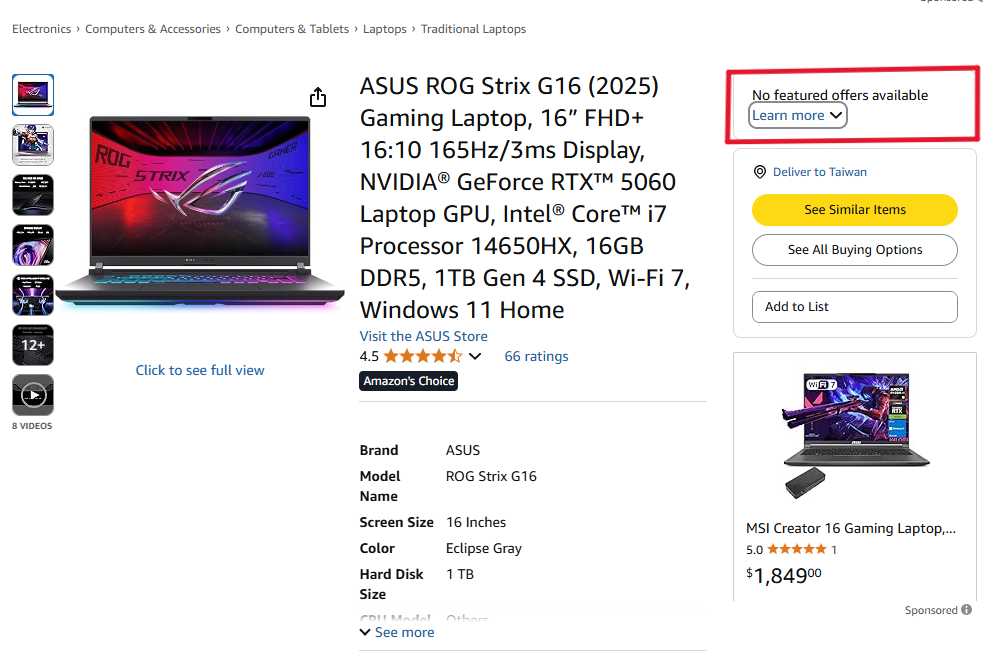
Why does the Buy Box get suppressed?
- Lower prices were found on Amazon or other online marketplaces.
- Weak seller metrics (e.g., negative feedback, late shipments). It could happen even when you are the only seller.
What happens when the Buy Box is suppressed?
Without the Buy Box (and Add to Cart), shoppers must click See All Buying Options, which can significantly reduce conversions.
How to recover a suppressed Buy Box
- Use price-tracking tools (e.g., Keepa) to compare market prices and see pricing history.
- Investigate your account health, and solve issues within your control, like late shipments or resolve negative customer feedback.
- If find that you can’t resolve a suppressed buy box after some effort, try contacting Amazon Seller Support.
Using BQool: Sellers have a choice between the When Buy Box is Suppressed setting in the rule-based repricer, or the Get The Buy Box setting AI-powered repricer in for more advanced repricing rule customization to adapt pricing and recover the suppressed Buy Box faster.
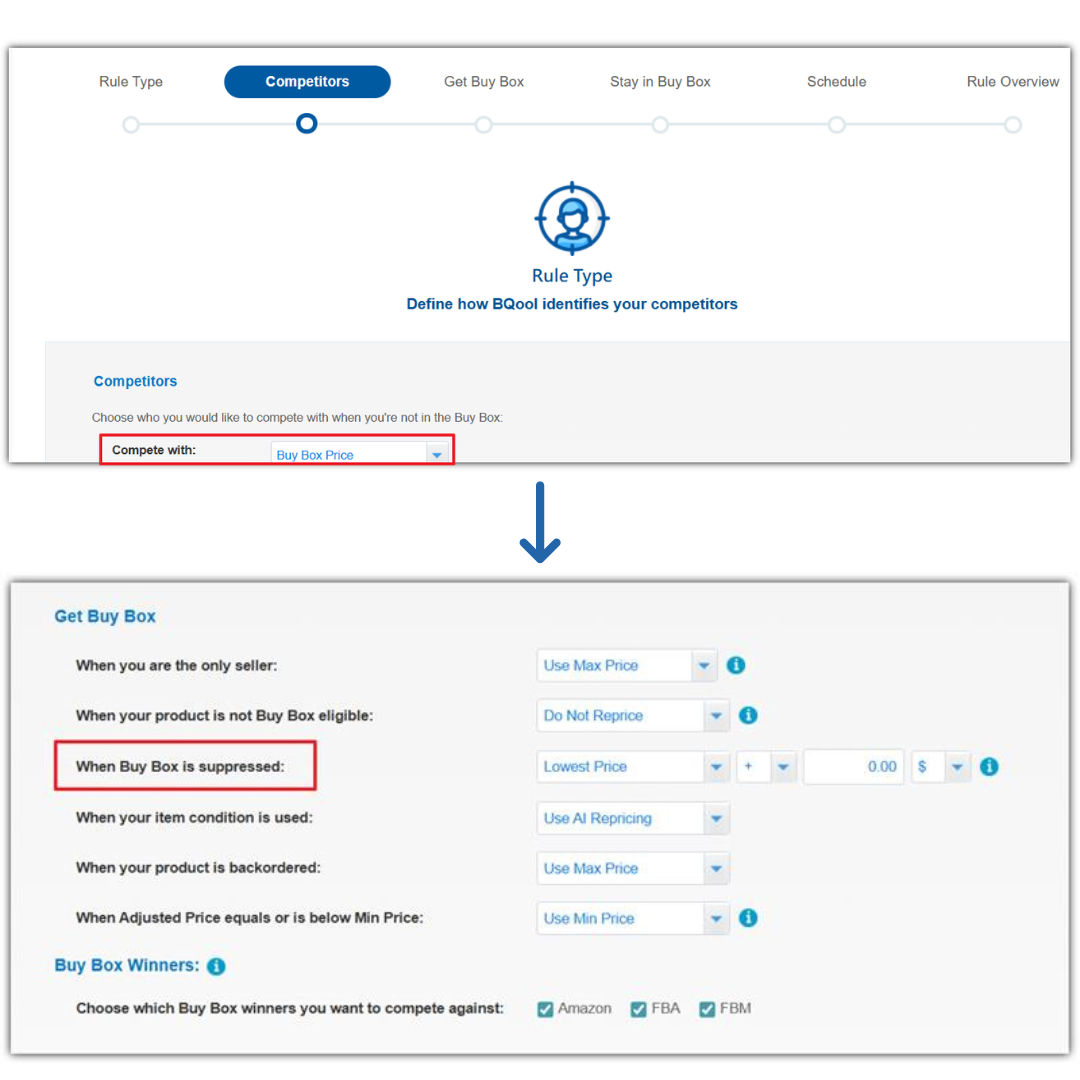
BQool’s Rule Based Repricer, When Buy Box is Suppressed Setting UI
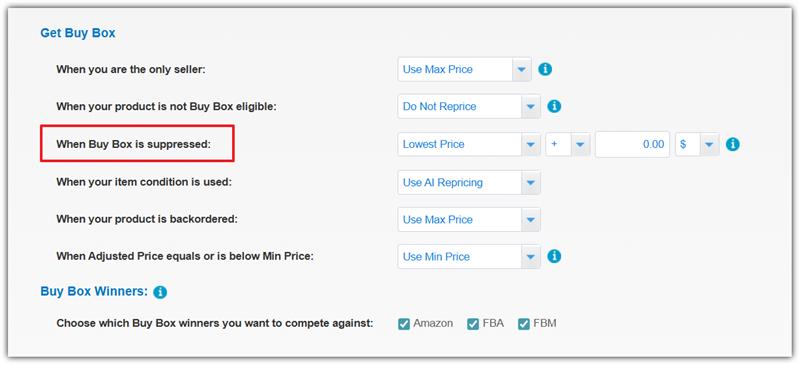
BQool’s AI-Powered Repricer, When Suppresed Buy Box setting UI
Common Buy Box Myths (Debunked)
Reality: Overall seller performance and fulfillment channels like FBA or Prime shipping can beat a slightly lower price. Even when sellers have low-quantity stock for high demand products, FBA would stand a better chance than FBM.
Reality: Newer or smaller sellers could beat established sellers who meet Amazon’s standards and win with better overall seller metrics.
Reality: It rotates among eligible offers, so sellers must continue to maintain performance.
Some believe that pricing within 2% of the current Buy Box price guarantees rotation. In reality, there is no fixed margin.
How can you win the Buy Box?
While Amazon’s algorithm is always evolving, chances of winning the Buy Box increases when you are consistent across pricing, fulfillment, and customer experience.
How to optimize your pricing strategy
Price remains one of the most influential factors in winning the Buy Box, but that doesn’t mean you should always undercut competitors. Instead, focus on setting appropriate minimum and maximum price ranges to protect your profit margins while still staying competitive.
BQool AI-powered repricing strategies:
- AI Win Buy Box: Designed for short-term growth, this strategy aggressively adjusts your price to maximize Buy Box ownership and increases sales velocity.
- AI Match Buy Box: A long-term strategy that focuses on maintaining profitability by matching Buy Box prices intelligently rather than racing to the bottom.
Types of repricing
- Manual: Manually adjusting your prices in Seller Central. This works for very small catalogs but is time-consuming.
- Rule-Based: Setting fixed rules (e.g., always stay $0.10 above the lowest offer). Easy to use but often too rigid in competitive markets.
- AI Repricing: The most advanced method, where software dynamically adjusts pricing based on competitors, Buy Box trends, and performance metrics. This approach is smart, adaptive, and designed to maximize Buy Box wins while protecting profits.
- Conditional: Allows sellers to change prices automatically based on conditions unique to their business, such as fulfillment channel, sales velocity, or Buy Box ownership. This gives sellers more flexibility and control over different scenarios.
Monitor competitor prices & product category trends
- Track competitor pricing with BQool’s competitor analysis tool, to identify who you’re competing against and how their pricing changes over time.
- Also keep an eye on category-specific changes. For example, electronics often reprice more aggressively than home goods. And seasonal products may have more Buy Box competition.
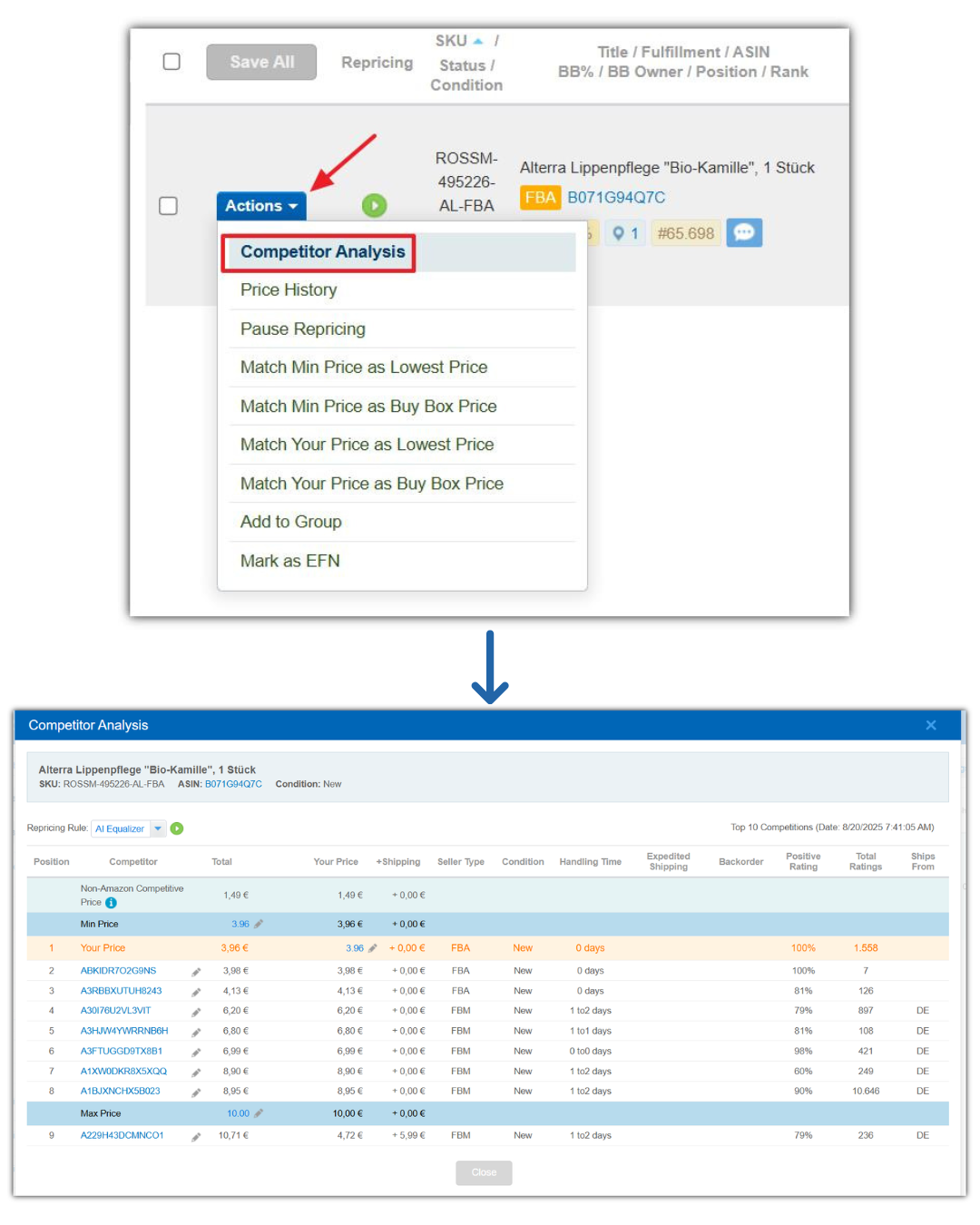
BQool Competitor Analysis Feature UI
Fulfillment & inventory
- Use FBA (Fulfillment by Amazon) for Prime eligibility and reliable shipping.
- Distribute inventory across Fulfillment Centers to reduce delivery times and increase chances to be the Featured Offer in multiple regions.
- Monitor product demand and keep an appropriate amount of inventory to avoid being out-of-stock (losing Buy Box eligibility).
Enhance customer experience
- Encourage positive reviews from customers and maintain listing accuracy and quality. Social proof boosts your Buy Box chances.
- Respond quickly to customer messages within 24 hours or less.
- Reduce number of returns and defects, and set clear expectations through an accurate representation of your listings.
FAQ: Amazon Buy Box
How do you win the Amazon Buy Box?
How does Amazon decide who gets the Buy Box?
How do I qualify for the Buy Box?
Why am I not winning the Buy Box?
The post What is the Amazon Buy Box? (And How to Win It) appeared first on BQool Blog.
New US shipping tariff from Canada makes Amazon Handmade unprofitable
Hi everyone,
Today I tried to ship an order from Canada to the US. The label I usually buy costs $8.50, but with the new rates that started today, I had to pay $22. At this price, it’s basically not profitable for my product anymore.
Does anyone have any advice or workaround for this?
submitted by /u/SnooCakes6581
[link] [comments]
New US shipping tariff from Canada makes Amazon Handmade unprofitable
Hi everyone,
Today I tried to ship an order from Canada to the US. The label I usually buy costs $8.50, but with the new rates that started today, I had to pay $22. At this price, it’s basically not profitable for my product anymore.
Does anyone have any advice or workaround for this?
submitted by /u/SnooCakes6581
[link] [comments]
How often does Amazon Win the Buy Box?
I know Amazon tends to give themselves the buy box, probably more often than an 3rd party seller could win it. Either by bending the rules, or just having the playbook that noone has. On average, what percentage of sales do you think Amazon takes on products that they sell. I was thinking 70-80% but maybe higher? Could be up to 100%
submitted by /u/cultureconneiseur
[link] [comments]
How often does Amazon Win the Buy Box?
I know Amazon tends to give themselves the buy box, probably more often than an 3rd party seller could win it. Either by bending the rules, or just having the playbook that noone has. On average, what percentage of sales do you think Amazon takes on products that they sell. I was thinking 70-80% but maybe higher? Could be up to 100%
submitted by /u/cultureconneiseur
[link] [comments]
Amazon Terminology Cheat Sheet
Are you confused by Amazon terminology and acronyms? Here, we define the most common Amazon terminology that ecommerce companies will find.
Ecommerce isn’t always easy to decode for beginners. Even once you gain your footing as a seller, there are many new terms and acronyms that you’ll continue coming across. This not only applies to general ecommerce tactics, but also to selling on Amazon.
That’s why we put together this Amazon terminology guide. We organized this list in groups and in alphabetical order for ease. Feel free to bookmark this cheat sheet and return to it in case there’s a word or phrase you don’t recognize.
Advertising Terms
- Ad orders. How often users purchase after clicking an ad.
- Ad sales. Total number of weekly sales that one ad generates.
- Ad status. Current standing of your ad―running, paused, or archived.
- Automatic targeted ads. Amazon displays your ads to users most likely to click on them.
- Amazon advertising. Various paid marketing services offered by Amazon.
- Bid. How much money you put towards an ad.
- Clicks. The number of times a user selects your ad.
- Daily budget. The amount you’re willing to spend on ads per day.
- Headline search ad. An ad that appears at the top of SERPs.
- Impressions. The number of times users see your ad.
- Manually targeted ads. Campaigns where you input the keywords and other details to ensure your ads are shown to those likelier to purchase a product.
- Pay-per-click (PPC). An advertising model where you only pay a fee when a user clicks on your ad.
- Product display ad. An ad that shows the product image, title, and copy.
- Spend. How much you spend on advertising in a specific time frame.
- Sponsored ad. A strategy to promote your products throughout Amazon.
- Sponsored brand. A strategy where sellers use branded visuals and other elements to promote their company on SERPs.
- Targeting. How or what you use to attract users in an ad campaign.
Amazon Terminology
- A-to-Z guarantee. A warranty designed to protect customers when they purchase from third-party sellers.
- A9 search engine. Amazon’s search algorithm.
- Amazon Condition Guidelines. Used to guarantee quality when buying new and used products.
- Amazon’s Choice. When Amazon recognizes a seller based on low prices, high product ratings, and shipping speed.
- Average sales rank. Measures how often you receive a best-seller rank compared to when you don’t.
- Best seller rank (BSR). How sellers compare to the competition.
- Brand registry. A service that recognizes trademarks to protect brands from fraud.
- Buy box. The area on a listing that displays product and purchase details.
- Early reviewer program. When a seller offers a new product for free or at a discounted price in exchange for an honest review.
- Enhanced brand content (EBC). An option to create more detailed product descriptions.
- European Article Number (EAN). 13-digit number that identifies products in the EU.
- Fulfillment by merchant (FBM). Fulfillment option where sellers ship products themselves.
- Identification codes (ASIN and SKU). Amazon’s product identification system.
- Lightning deals. An Amazon feature where sellers set specific items at a discount.
- Listing. The web page where customers can learn about and purchase individual products.
- Listing quality score. When Amazon assigns a rating to a listing based on details like keywords, bullet points, titles, images, and descriptions.
- MSKU. Identifier to differentiate the FNSKU from the SKU.
- Performance notifications. A page that lists various customer satisfaction metrics.
- Piggybacking. When more than one seller is on the same listing.
- Prime. Subscription where customers receive perks like free and fast shipping.
- Referral fee. Percentage-based fee that Amazon charges sellers for selling on their platform.
- Seller Central. Your Amazon backend, where you’ll conduct business from.
- Storefront. Branded stores on Amazon.

Analytics Terms
- Average cost of sale (ACOS). Metric that measures how well your ads perform, based on how much you spend on advertising to generate a sale.
- Conversion rate. Percentage of users who visit your store and become customers.
- Cost of goods sold (CoGS). The total cost you spent to create or sell a product.
- Cost-per-click (CPC). The price an advertiser pays when a user clicks their ad.
- Cost-per-thousand (CPM). The amount you pay when 1,000 users see an ad.
- Return on investment (ROI). The amount of money you earn compared to how much you spent to advertise or market that product.
Business Terms
- Business-to-business (B2B). When companies sell directly to other businesses.
- Business-to-consumer (B2C). When companies sell to individual buyers for non-business needs.
- Business model. The way an organization generates revenue, operates its company, creates its products, and identifies its customers.
Ecommerce Terms
- Average price. The general cost of a product.
- Bump. A discounted product offered during the checkout process.
- Buy-one-get-one (BOGO). A promotion where a customer buys two products but pays for only one.
- Category. A group of similar items or ones in the same niche.
- Coupon. A promotion where users can save money on their purchase.
- Deals. Products offered at a discounted price for a limited time.
- International Standard Book Number (ISBN). 13-digit number assigned to books that publishers and authors use for KDP and other marketplaces.
- Inventory. Collection of products in stock.
- Logistics. The process of managing products stored in warehouses and other facilities.
- Manufacturer’s suggested retail price (MSRP). The price you sell your products, suggested by its manufacturers.
- Minimum advertised price (MAP). The minimum price set by suppliers.
- Omnichannel. Integrates different eCommerce channels.
- Online arbitrage (OA). Buying items to resell online.
- Opportunity score. Rating that signifies the demand for a product.
- Price match (PM). Pricing strategy that represents what competitors are charging for the same or similar item.
- Private label. Putting your name or logo on a generic product and selling it as a branded item.
- Promotion. Special perks, such as discounts, that sellers offer to customers.
- Retail arbitrage (RA). Buying underpriced items to resell.
- Shipping. Moving an order from the warehouse to the customer’s address.
- Target. American retail corporation that offers online and in-store shopping.
- Upsell. Promotion strategy where the seller encourages customers to purchase more products in an order.
- Walmart. American retail corporation that offers online and in-store shopping.
- Wholesale. Purchasing large quantities of items to sell under your name.
FBA Terms
- Fulfillment by Amazon (FBA). A fulfillment option where sellers send their inventory to Amazon warehouses and Amazon handles the picking, packing, and shipping.
- Fulfillment center. Amazon’s warehouses where products are stored and shipped.
- Fulfillment fee. The expenses a seller pays for FBA.
- Fulfillment Network Stock Keeping Unit (FNSKU). The unique identifier that Amazon uses to find products sent to their warehouses.
- Variable closing fee. A fixed cost that Amazon charges to send specific products on its platform.
Global Ecommerce Terms
- Customs clearance. The official department that handles goods passing through a country’s border to be sold.
- Duty tax. A tax paid on imported and exported products.
- Export. Sending goods to another country to sell them.
- Global expansion. The process of expanding business operations to one or more countries overseas.
- Import. Bringing goods into another country to sell them.
- Value-added tax (VAT). Consumption tax added to all products purchased in the European Union (EU).
Marketing Terms
- A/B testing. When a seller tests two versions of a product listing, landing page, ad, etc., and sees which one generates the best results.
- Affiliate. An individual or organization that promotes your products for a commission.
- Affiliate marketing. A tactic where a seller partners with an individual or organization to promote their product in exchange for a commission of all sales they bring in.
- Giveaway. A strategy where a seller offers a free product to customers in exchange for free promotion (usually on social media).
- Landing page. A page that users click to convert them into a customer. A product listing can also be a landing page.
- Lead magnet. A free or cheap product or service that businesses offer in exchange for something from the user, usually their contact information.
- Marketing. Tactics used to attract customers to your business.
- Opt-in. A form users fill out to connect with a website. It can be a form for a lead magnet or to subscribe to a newsletter.
- Sales funnel. An illustration that tracks the average journey one experiences toward buying a product.
- Sales page. A web page that entices users to purchase a product or service.
- Squeeze page. A web page enticing users to fill out an opt-in form.
Sales and Profit Terms
- Average monthly sales. Average revenue generated in a month.
- Financial statements. Detailed reports of your income.
- Gross profit. Amount a business makes after deducting its expenses.
- Net income. The income you earned after deducting total business expenses.
- Profit and loss statement. Report on the revenue generated, compared to how much you spent.
- Profit margins. The percentage you earn from a sale after deducting the cost of manufacturing, marketing, etc.
- Q1, Q2, Q3, and Q4. “Q” is an acronym for “quarter,” indicating the quarterly periods for each year.
- Revenue. Total income from product sales.
- Sales. Amount of products sold, usually over a period of time.
SEO Terms
- Keyword. A term that users enter into search engines.
- Search engine optimization (SEO). Tactics that marketers use to appear on search results.
- Search engine position. The position your page is at on a SERP.
- Search engine results page (SERP). The results that a search engine generates after a user enters a query.
- Search volume. The number of times a user searched a keyword in a specific timeframe (usually one month).
- Traffic. The number of users who visit your website or product page.
Use Our Amazon Terminology Cheat Sheet for Your Business
Are you still confused about this Amazon glossary of terms? While this Amazon terminology sheet covers the most basic words that all sellers should know, it’s far from a comprehensive list.
If our Amazon terminology guide has any terms or acronyms that confuse you, you may need extra assistance. Don’t hesitate to schedule a free call with us. We can answer any questions you have and can help you create a powerful selling strategy to succeed online.
Author
 Stephanie Jensen has been writing ecommerce content for seven years, and her copy has helped numerous stores rank on Amazon. Follow her on LinkedIn for more insight into freelance writing and creating high-quality content.
The post Amazon Terminology Cheat Sheet appeared first on AMZ Advisers.
Emoji in the bullet point
Hello guys,
I read that Amazon forbids to insert the emoji in the bullet point, is that true in your opinion? Thanks for your comment
submitted by /u/alexdepeers
[link] [comments]
Emoji in the bullet point
Hello guys,
I read that Amazon forbids to insert the emoji in the bullet point, is that true in your opinion? Thanks for your comment
submitted by /u/alexdepeers
[link] [comments]

