
Are there ever cases where one can get 100% of their money back with Safe T claims?
I was just reading someone’s experience with wanting to quit selling on Amazon due to the fraudulent environment/ lack of seller support and it really resonated for me. I had another case of clear cut buyer fraud: they bought 4 items totaling over $400 and filed a refund claiming they didn’t receive the order.
This is where my frustration begins: its so obvious through tracking that they DID receive the package: it was delivered to a parcel locker so its not like they can claim that it disappeared from their front door. The fact that they dish out refunds so easily and lazily without even checking the most basic details is mind blowing.
Then once I filed the Safe-T claim with clear evidence/ screenshots of the delivered package, along with proof that I tried to email the customer but they blocked communications, I guess one could say Im lucky I even got any refund at all.
But this is the second time its happened and each time I get something like 75% of my money back. Where does the rest of it go?
Why does the seller get punished for the buyer’s fraudulent behavior?
This same buyer immediately ordered another product right after filing the refund, which should have also been another red flag to Amazon: why would they order another product from the same seller if they allegedly didn’t receive the original order? I canceled this order because I refuse to do business with scammers and thieves, but now I also worry about retaliation.
Seller support/ account help support are all completely worthless. They don’t care; you can barely understand wtf they’re even saying, and when following their directions, I still get error messages stating that I filed buyer fraud in the wrong place (and then they just reroute you to the same page with no other options other than speak with another useless account health specialist.)
Sorry for my long rant. Clearly this is extremely aggravating.
submitted by /u/Tricky_Ad_4041
[link] [comments]
Can’t log in to Seller Central?
Get this message when I try:
“For added security, we need to verify your phone number. We are unable to send an SMS to the phone number ending [number] at this time.”
Tried the other phone number on the account, and the other call method too.
submitted by /u/IllustriousLibrary8
[link] [comments]
Can’t log in to Seller Central?
Get this message when I try:
“For added security, we need to verify your phone number. We are unable to send an SMS to the phone number ending [number] at this time.”
Tried the other phone number on the account, and the other call method too.
submitted by /u/IllustriousLibrary8
[link] [comments]
#508 – The TikTok Shop Playbook for Creator-Driven Growth
Audio version above. Video version below
What does it really take to turn small creators into big sales on TikTok Shop? In this episode of the AM/PM Podcast, Shivali Patel sits down with Josh Hadley to unpack the systems, strategies, and mindset shifts that helped him build an affiliate army of more than 5,000 creators. Josh shares how TikTok Shop helped revive his business during a difficult season and why sellers should stop treating creator marketing like a side tactic and start treating it like a real growth engine.
A big takeaway from this episode is that success on TikTok Shop does not come from sending random samples and hoping for the best. Josh explains how brands need to get laser-focused on their target audience, identify the right creator profiles, and build outreach systems that actually lead to responses. He walks through how his team finds creators, studies competitors, uses outreach tools, sets commission structures, manually approves samples, and gets creators off-platform to build stronger, long-term relationships. His approach is less about chasing big influencers and more about finding the right smaller creators with strong content potential.
Josh also dives into what most sellers are missing after the first outreach. He explains how creative briefs, email nurture flows, contests, and regular communication help turn one-time creators into loyal brand ambassadors. For Amazon sellers, this episode is especially valuable because it shows how TikTok Shop can complement an existing brand when the right SOPs, systems, and team are already in place. If you have been wondering how to get creators to actually post, how to compete with brands using similar tactics, and how to make TikTok Shop work without abandoning Amazon, this episode offers a detailed, actionable blueprint.
In episode 508 of the AM/PM Podcast, Shivali and Josh discuss:
- 00:00 – Introduction
- 00:52 – Josh Hadley’s Background And Why TikTok Shop Matters
- 02:46 – When Amazon Sellers Should Expand To TikTok Shop
- 06:22 – The Playbook Behind 40 Viral Videos And 5,000 Creators
- 07:14 – From Business Struggles To A TikTok Shop Breakthrough
- 11:51 – How To Find The Right Creators And Study Competitors
- 19:38 – Bots, Targeted Collaborations, And Sample Approval Strategy
- 24:58 – Why Off-Platform Creator Contact Is Critical
- 27:28 – Email Nurture, Creative Briefs, And Getting More Creator Posts
- 28:54 – Commission Rates, Creator Selection, And Why Small Creators Win
- 36:32 – Fulfillment, Creator Retention, And Long-Term Relationship Building
- 45:06 – Why TikTok Shop Is Still A Gold Rush For Brands
Enjoy this episode? Want to be able to ask questions to Leo Sgovio live in a small group with other 7 and 8-figure Amazon sellers? Join the Helium 10 Elite Mastermind and get quarterly workshops, monthly training, and networking calls with Leo at h10.me/elite
Make sure to subscribe to the podcast on iTunes, Spotify, or wherever you listen to our podcast!
💰 Get Helium 10 with a special discount to start or scale your e-commerce business here: https://h10.me/h10
Want to absolutely start crushing it on eCommerce and make more money? Follow these steps for helpful resources to get started:
- Get the Ultimate Resource Guide from Bradley Sutton, Carrie Miller, and Shivali Patel for tools and services that he uses every day to dominate on Amazon!
- New to Selling on Amazon? Freedom Ticket offers the best tips, tricks, and strategies for beginners just starting out! Sign up for Freedom Ticket.
- Trying to Find a New Product? Get the most powerful Amazon product research tool in Black Box, available only at Helium 10! Start researching with Black Box.
- Want to Verify Your Product Idea? Use Xray in our Chrome extension to check how lucrative your next product idea is with over a dozen metrics of data! Download the Helium 10 Chrome Extension.
- The Ultimate Software Tool Suite for Amazon Sellers! Get more Helium 10 tools that can help you optimize your listings and increase sales for a low price! Sign up today!
- Does Amazon Owe YOU Money? Find Out for FREE! If you have been selling for over a year on Amazon, you may be owed money for lost or damaged inventory and not even know it. Get a FREE refund report to see how much you’re owed!
- Check out our other Amazon FBA podcasts including the Serious Sellers Podcast, as well as our Spanish and German versions!
- You can also listen to the AM/PM Podcast on YouTube here!

The post #508 – The TikTok Shop Playbook for Creator-Driven Growth appeared first on AM/PM Podcast.
I quit amazon within 25 days.
Hi Everyone,
I’m posting this for new sellers who are planning to start on Amazon.
I began selling in early March with a lot of enthusiasm. My products are genuine and original, and I was already doing fairly well in the offline market. I decided to expand online to increase sales.
I listed my products at reasonable prices, expecting steady growth. However, I soon realized that things are not as straightforward as they seem.
I fulfilled 10 orders. Out of those, 6 had return requests raised incorrectly by buyers. In all these cases, I received completely different products in return, which clearly indicates a swap scam.
As part of my standard process, I record videos of all order packings. I have clear proof showing that the correct products were packed and shipped as per the listings.
I am currently facing two major issues:
Product Swap Fraud:
Buyers are returning different items while keeping the original product. Even with proof, I am required to issue a full refund along with Amazon fees. This results in a triple loss on a single genuine order.
ATS Delivery Issues:
My returned products are not being delivered back to me through ATS. Despite contacting seller support multiple times, there has been no resolution. Surprisingly, seller support claims they do not have access to the ATS system. If that’s the case, why is ATS being used for returns when it cannot be tracked or supported?
This experience has been extremely disappointing and concerning, especially for new sellers trying to build a genuine business.
submitted by /u/CollectionLittle9205
[link] [comments]
I quit amazon within 25 days.
Hi Everyone,
I’m posting this for new sellers who are planning to start on Amazon.
I began selling in early March with a lot of enthusiasm. My products are genuine and original, and I was already doing fairly well in the offline market. I decided to expand online to increase sales.
I listed my products at reasonable prices, expecting steady growth. However, I soon realized that things are not as straightforward as they seem.
I fulfilled 10 orders. Out of those, 6 had return requests raised incorrectly by buyers. In all these cases, I received completely different products in return, which clearly indicates a swap scam.
As part of my standard process, I record videos of all order packings. I have clear proof showing that the correct products were packed and shipped as per the listings.
I am currently facing two major issues:
Product Swap Fraud:
Buyers are returning different items while keeping the original product. Even with proof, I am required to issue a full refund along with Amazon fees. This results in a triple loss on a single genuine order.
ATS Delivery Issues:
My returned products are not being delivered back to me through ATS. Despite contacting seller support multiple times, there has been no resolution. Surprisingly, seller support claims they do not have access to the ATS system. If that’s the case, why is ATS being used for returns when it cannot be tracked or supported?
This experience has been extremely disappointing and concerning, especially for new sellers trying to build a genuine business.
submitted by /u/CollectionLittle9205
[link] [comments]
How to Find Keywords for Amazon PPC in 2026
Overview
- What Is Amazon PPC and How Keywords Influence Ads
- Types of Amazon PPC Keywords to Target
- How to Discover Amazon PPC Keywords
- How to Identify Profitable Amazon PPC Keywords
- How to Use PPC Keywords in Amazon Listings
- Refining Your PPC Campaign Using Search Terms Reports
- Conclusion
With millions of daily product searches, Amazon has become the go-to platform for high-intent shoppers, over 56% of consumers now start their product searches on Amazon, compared to 42% on search engines like Google (eMarketer, 2024). This makes Amazon PPC a powerful way to reach customers who are ready to buy.
But success depends on your keywords. Amazon only shows your ads when your keywords match what shoppers are searching for, so the right keywords drive visibility and sales, while the wrong ones limit reach or attract irrelevant clicks.
If your targeting is off, you may still get impressions and clicks, but they rarely convert, leading to wasted ad spend.
In this article, we break down how to choose the right keywords and what truly drives results.
Amazon PPC seems straightforward at first. You bid on keywords, your ads appear in search results or on product pages, and you pay when someone clicks.
What makes it effective is relevance. The keywords you choose act as the bridge between your potential customer and the product you are advertising. Choosing highly relevant keywords is like building a short, direct bridge, your ads are more likely to show and at a more efficient cost. In contrast, weaker relevance is like building a longer bridge, your ads may not appear or may become more expensive without delivering results.
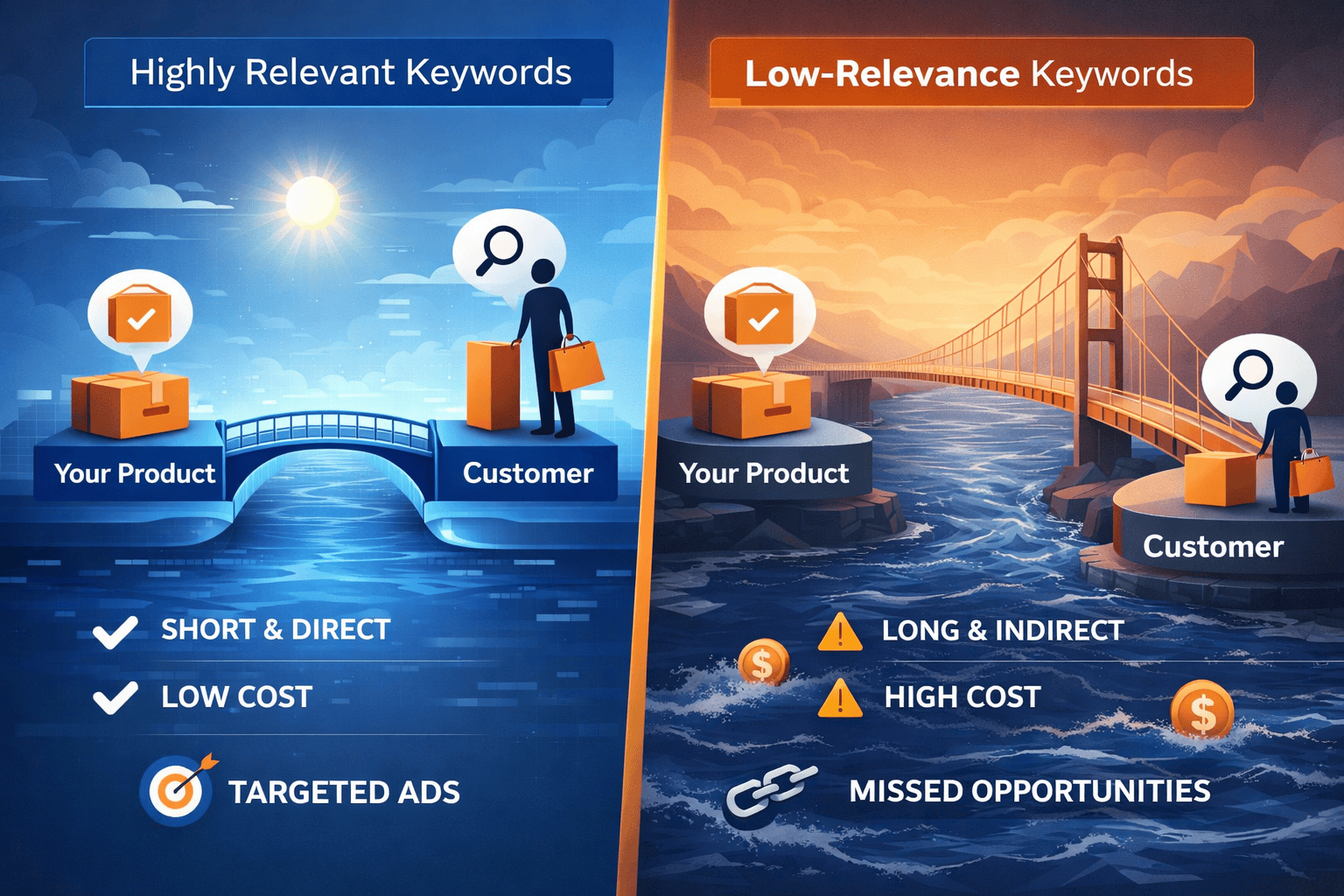
Keywords selection is important because it determines when your ads appear and influence cost-per-click (CPC). More competitive keywords drive higher costs per click, which in turn impacts ad placement and visibility.
When you have the right keywords in place, your campaigns are not just generating traffic, they are attracting shoppers who are more likely to convert.
Types of Amazon PPC Keywords to Target
Not all keywords serve the same purpose and treating them the same leads to inefficient campaigns. A more effective approach is to think in terms of shopper intent and where someone is in their buying journey. There are three main types of keywords to target:
- High-intent keywords are closest to purchase. These are direct product searches, such as “wireless noise-cancelling headphones,” where the shopper already knows what they are looking for. They tend to convert well but come with higher competition and cost.
- Mid-intent keywords reflect “window shopping” behavior. Searches like “best headphones for travel” suggest the shopper is still considering options. While these may not convert immediately, they are useful for capturing attention early and influencing purchase decisions.
- Long-tail keywords are more specific and descriptive. A search like “lightweight noise-cancelling headphones for flights” provides a clearer picture of what the shopper wants. These keywords usually have lower competition and CPC, but often convert at a higher rate because the intent is clearer.
Strong campaigns typically combine all three types. High-intent keywords drive conversions, mid-intent keywords expand reach and awareness, and long-tail keywords improve efficiency.
How to Discover Amazon PPC Keywords
Keyword discovery is not a one-time task. It is an ongoing process that starts with educated guesses and becomes more refined as you collect data.
Analyzing competitors is a strong starting point. Their sponsored ads, product titles, and bullet points can reveal which keywords they prioritize. If the same terms appear across multiple top-performing listings, it usually signals strong demand and relevance.
Another good starting point is seed keywords, core terms related to your product, including its category, key features, and use cases. For example, a Bluetooth speaker might be associated with terms like “portable,” “waterproof,” or “outdoor.” These initial keywords help generate more specific ones over time.
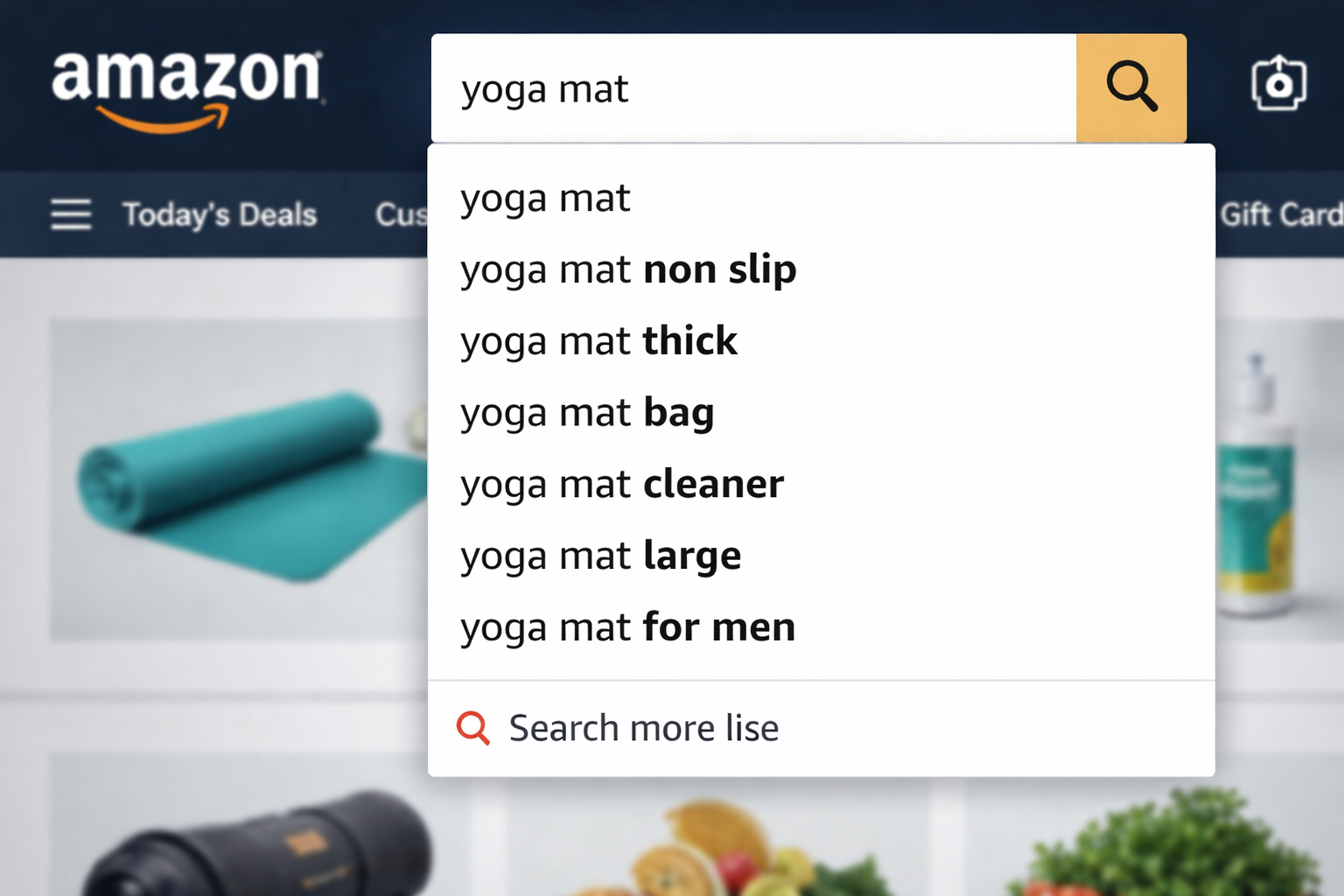
From there, Amazon’s search bar becomes a valuable resource. The autocomplete suggestions are based on real shopper behavior, making them a reliable indicator of what people are actively searching for. If certain phrases consistently appear, it is usually a sign of strong demand.
Keyword research tools and PPC platforms can further support this process by suggesting related keywords and identifying profitable opportunities, this is especially useful when scaling campaigns.
How to Identify Profitable Amazon PPC Keywords
Not every keyword that drives traffic is worth keeping. The goal is to identify keywords that generate profitable sales, not just clicks.
Three key factors to evaluate are:
| Keyword Factor | Metric to Look Out For | Why It’s Important |
|---|---|---|
| Demand | Search volume | Indicates traffic potential |
| Cost | Average CPC | Impacts margin and spend |
| Conversion potential | Sales per click | Determines ROI |
It’s important to consider all three factors rather than focusing on just one. A high-volume keyword may seem appealing, but if it has high costs and low conversion rates, it can quickly drain your budget. On the other hand, a lower-volume keyword with strong conversion and lower cost can deliver better returns over time, even with fewer sales.
In practice, this means regularly reviewing your search term reports and campaign data, then making decisions based on real performance rather than assumptions.
Automation tools can help identify high-performing and under-performing keywords, but understanding what drives profitability allows you to make better strategic decisions.
How to Use PPC Keywords in Amazon Listings
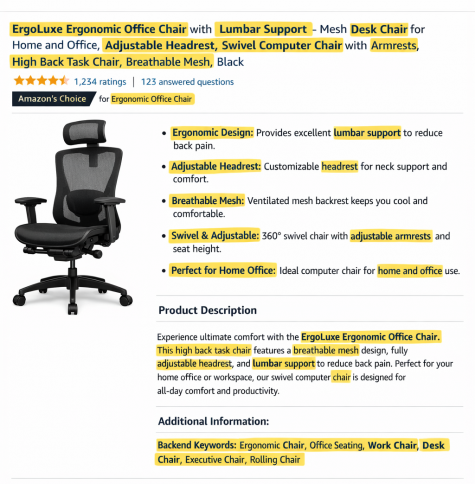
Keywords should not be limited to ads, they should also be integrated into your product listings.
When your listing content aligns with your PPC keywords, it strengthens relevance and can improve both ad performance and organic visibility.
Key areas to include target keywords:
- Product title
- Bullet points
- Product description
- Backend search terms
However, avoid keyword stuffing. Your content should still read naturally and clearly communicate the product’s value.
Refining Your PPC Campaign Using Search Terms Reports
You can also use the Amazon Search Terms report (available to users who are actively running Amazon Sponsored Products and Brands campaigns), which provides insight into actual customer queries that triggered your ads and led to clicks or sales. Over time, this becomes one of the most effective ways to refine your keyword strategy.
1. Get keyword ideas from search term report
Amazon sellers can use their Search Term Reports to uncover high-performing keywords and eliminate wasted spend.
2. Build your negative keywords list
Another effective keyword strategy is not just about inclusion, but also exclusion.
Negative keywords prevent your ads from appearing in irrelevant searches. For example, if you sell a premium product, you might exclude terms like “budget” to avoid attracting low-intent clicks.
3. Refine keyword match type strategy
Many sellers structure campaigns in stages, starting with broader targeting (broad or phrase match) to discover new keywords, then refining into more controlled campaigns using exact match.
This creates a continuous cycle of testing and optimization. High-performing keywords receive more budget and more precise targeting, while under-performing ones are reduced or removed.
Over time, this improves traffic quality. You spend less on unqualified clicks and allocate more budget toward high-intent searches.
Conclusion
When you select keywords effectively, wasted ad spend decreases and return on ad spend (ROAS) improves. While it may seem like a small adjustment, it plays a significant role in increasing Amazon ROI without raising your overall budget.
The post How to Find Keywords for Amazon PPC in 2026 appeared first on BQool Blog.
Online Arbitrage questions for anyone doing it — Need some advice!
Hey Everyone,
I have sold OA/RA in the past (like 10+ years ago) and it was all a manual process. I hired Filipinos to look for products using specific criteria and as the years gone by, it got harder so I gave up and moved to private label instead.
However, today that’s all changed and it seems apps like Tactical Arbitrage have made that process simpler from what I’ve read on their site. They have lists of stores and an automated way to find products on those stores (sounds too good to be true!)
For those who’re ACTIVELY sourcing products online (arbitrage.. NOT wholesale or PL), what do you think of the app Tactical Arbitrage? https://tacticalarbitrage.com
Thanks in advance for your help!!
submitted by /u/LogicalMight
[link] [comments]
Online Arbitrage questions for anyone doing it — Need some advice!
Hey Everyone,
I have sold OA/RA in the past (like 10+ years ago) and it was all a manual process. I hired Filipinos to look for products using specific criteria and as the years gone by, it got harder so I gave up and moved to private label instead.
However, today that’s all changed and it seems apps like Tactical Arbitrage have made that process simpler from what I’ve read on their site. They have lists of stores and an automated way to find products on those stores (sounds too good to be true!)
For those who’re ACTIVELY sourcing products online (arbitrage.. NOT wholesale or PL), what do you think of the app Tactical Arbitrage? https://tacticalarbitrage.com
Thanks in advance for your help!!
submitted by /u/LogicalMight
[link] [comments]
Same customer – same product – 2 different states
So I haven’t sold on Amazon now for some time since I got undercut so bad by competitors. I got an order about a week ago for one of my products. Honestly, I was just going to let it go and let it get cancelled. This was the first order I have gotten in months when I used to get hundreds per month. It’s now a week later and I got an order for the same product, same color, and now I noticed it’s the same customer, but they are now in Orlando instead of Texas.
The original order was from Texas, and the new one is from Orlando. Name is exactly the same and even Amazon shows it’s the same customer (now with 2 orders). Seems really fishy to me.
Would you fulfill it?
submitted by /u/beej1254
[link] [comments]

